
Start with the biology, because the biology is where this gets interesting. Oxytocin is a hormone your pituitary gland already makes, a nine-amino-acid peptide that your body uses for two jobs it has done since before anyone thought to bottle it: triggering labor contractions and letting milk down during breastfeeding. PT-141, known chemically as bremelanotide, is nothing like that. It is a synthetic peptide engineered to act on melanocortin receptors in the brain, mainly a receptor called MC4R, which researchers believe plays a role in sexual desire. One is an endocrine signal your body evolved to run childbirth. The other is a lab-built molecule aimed at a specific brain receptor. They get marketed side by side as “intimacy peptides.” Mechanistically, they barely belong in the same sentence.
That distinction turns out to matter enormously once you look at what the trials actually show, and where each drug’s evidence quietly runs out.
The FDA approval each one actually has
Both molecules carry an FDA approval, and sellers lean on that word hard. Neither approval covers what most buyers are shopping for.
Oxytocin’s only approval is the injectable hospital drug, used to induce or augment labor and to control postpartum bleeding [P1]. The nasal spray version marketed for bonding, calm, or intimacy is compounded and prescribed off-label. It has never been approved for any of that.
PT-141’s approval is narrower but more relevant to the desire question. The FDA cleared it in 2019 under the brand name Vyleesi, specifically for premenopausal women with acquired, generalized hypoactive sexual desire disorder, and that approval rests on actual randomized trial data [P2]. Nearly everyone else using it, including every man who tries it, is using it off-label.
So both molecules have an approval line that sounds reassuring in an ad. Neither approval matches the use case being sold around it. That is the first thing worth clearing up before anyone compares them on effectiveness.
What the trials actually found
Here is where the two stories diverge sharply, and it is worth walking through both.
PT-141’s case rests on the RECONNECT program: two randomized, double-blind, placebo-controlled Phase 3 trials, roughly 1,267 premenopausal women with HSDD enrolled across them [P2]. Bremelanotide beat placebo on sexual desire and on reduced distress, with statistically significant results. The effect, though, was modest, not a dramatic switch flipping on, and the population tested was specific: premenopausal women. Extending that finding to men is exactly that, an extension, not something the controlled trials measured.
Oxytocin’s intimacy case is thinner. The famous early trust study that built its “love hormone” reputation has largely failed to replicate. A 2016 methodological analysis of the broader oxytocin literature estimated that the average study in healthy subjects had only about 16 percent statistical power, and about 12 percent in clinical studies, concluding that most reported positive findings are probably false positives [P5]. The largest, most rigorous test to date, a 290-person randomized trial in autistic children and adolescents using daily intranasal oxytocin at roughly 48 IU/day over 24 weeks, found no significant benefit over placebo on its primary social-functioning measure [P6]. For desire specifically, there is nothing on the scale of RECONNECT behind oxytocin. Just a handful of small studies with mixed, modest results.
The gap, and it is a different gap for each drug
This is the part that gets flattened in most comparisons, and it deserves separating out, because the two molecules fail in genuinely different ways.
Oxytocin’s gap is a delivery problem. Even setting aside the question of whether it works, there is real doubt about whether enough of a nasal spray dose reaches the brain to do anything at all. A 2016 pharmacokinetic analysis concluded that very little of the oxytocin applied to the nasal mucosa appears to reach the cerebrospinal fluid, even as peripheral blood levels rise sharply [P3]. So oxytocin’s uncertainty starts before the receptor question ever comes up. It is unclear the molecule is arriving where it would need to work.
PT-141’s gap is a population problem, not a delivery problem. Its mechanism on MC4R is well defined, and the RECONNECT trials show it does something measurable at the group level. But that measurable something was demonstrated in premenopausal women with a specific diagnosis. Off-label use in men, or in women outside that population, is a leap the controlled science never actually tested. The receptor pharmacology travels; the trial evidence does not, at least not yet.
Put simply: oxytocin’s open question is whether the dose gets to the target. PT-141’s open question is whether the target population that was tested has anything to do with the person buying it off a website.
Side by side
| Question | Oxytocin (intranasal, wellness use) | PT-141 (bremelanotide) |
|---|---|---|
| Sold for | Bonding, calm, social ease, some intimacy | Sexual desire, mainly |
| FDA-approved for that goal | No. Approved only as an IV drug for childbirth [P1] | Approved for premenopausal women with HSDD; off-label for everyone else [P2] |
| Human evidence for the goal | Weak: small, mixed, hard to replicate | Stronger: randomized Phase 3 trials, modest effect [P2] |
| Does it reliably reach the target | Debated whether the spray even reaches the brain [P3] | Defined central mechanism at MC4R [P2] |
| Main downsides | Underpowered evidence, unknown long-term use | Nausea in about 40 percent; transient blood-pressure rise; skin pigmentation with frequent use [P4] |
| Red flag for self-dosing | No validated dose, uncertain delivery | Cardiovascular contraindication written into the FDA label [P4] |
What the better evidence costs you
It would be a mistake to read “PT-141 has stronger evidence” as “PT-141 is the safer choice.” The FDA label lays out a fairly specific price for that stronger evidence [P4].
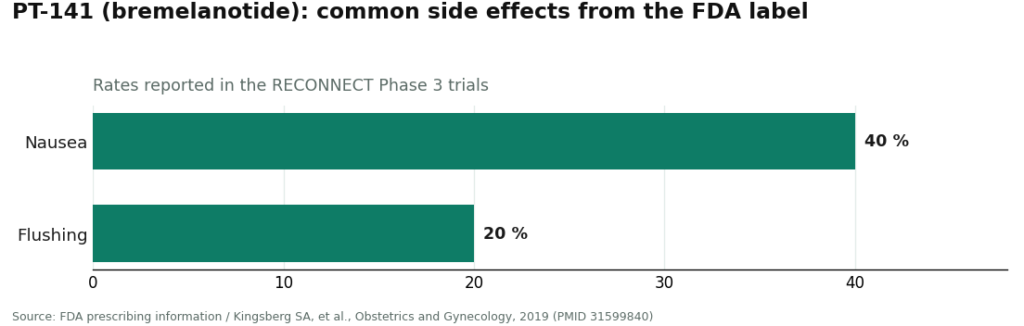
Nausea showed up in about 40 percent of patients in the trials, flushing in about 20 percent, with headache and injection-site reactions also common. The nausea was significant enough that a meaningful share of patients needed anti-nausea medication or stopped taking the drug, though it tended to ease after the first dose [P4]. More consequential is what happens to blood pressure: bremelanotide transiently raises it and lowers heart rate after each dose, which is why it is contraindicated in people with uncontrolled hypertension or known cardiovascular disease [P4]. Frequent dosing has also been linked to focal hyperpigmentation, darkened patches of skin [P4]. So the molecule with the stronger trial evidence is also the one that needs a blood-pressure check and a cardiovascular history before anyone touches it, not after.
Which one fits which goal
Framed by the goal rather than the marketing copy, the decision reads like this. For sexual desire, PT-141 carries real trial evidence behind it, and oxytocin is the comparatively weak bet for that specific job. But PT-141’s evidence comes bundled with a cardiovascular contraindication and a real nausea rate, which is a strong argument against dosing it from an unscreened vial. For something vaguer, a general sense of calm or connection rather than desire itself, neither molecule has strong evidence, though that fuzzier goal is at least the lane oxytocin has been studied in, however thinly. And if the expectation is a reliable, proven fix either way, neither molecule earns that label: oxytocin because the evidence is thin, PT-141 because its real benefit is modest and tied to a population most buyers do not belong to.
Neither of these belongs on a home-dosing A/B test between two vials. PT-141 moves blood pressure with every dose. Oxytocin has no validated wellness dose and an uncertain path to the brain in the first place [P3][P4]. The choice, whichever way it goes, is one to make with a clinician who can actually screen for the relevant risks.
Why the selling channel matters more than people assume
Both molecules get sold the same reckless way online, as vials labeled “for research use only,” with no clinician, no prescription, and nobody accountable for what is actually inside. For PT-141 that omission is especially dangerous, because nobody is screening buyers for the cardiovascular contraindication written into its own label [P4]. For oxytocin it means dosing a product of unknown strength through a delivery route that pharmacokinetic data already questions [P3]. No regulator has confirmed either bottle contains what the label claims, at the amount claimed, made cleanly.
The harm-reduction fix is the same for both molecules: route the decision through a licensed clinician rather than a research-chemical cart. FormBlends is one name built on that structure, a clinician review that screens for the relevant risks before anything ships, a prescription only where it’s appropriate, and a licensed compounding pharmacy that fills and sends the order, with follow-up afterward. What that structure adds is exactly what a “research use only” vial removes: on PT-141 in particular, the difference between a clinician catching a blood-pressure contraindication and nobody catching it at all.
The comparison, compressed
Oxytocin and PT-141 are different molecules solving different problems with different quality of evidence behind them. For sexual desire, PT-141 has genuine FDA-approved Phase 3 data, though the effect is modest, the tested population narrow, and the side-effect profile includes frequent nausea and a cardiovascular contraindication [P2][P4]. Oxytocin’s intimacy and bonding claims rest on thin, mixed, underpowered studies, with real doubt about whether the nasal spray even reaches the brain [P3][P5][P6], and its only solid approval remains childbirth [P1]. Choose based on the actual goal, not the price tag, and treat neither as a guaranteed fix bought without a clinician in the loop.
What people tend to ask
Is oxytocin or PT-141 better for low libido?
For sexual desire specifically, PT-141 (bremelanotide) has the stronger evidence, having earned an FDA approval for low desire in premenopausal women based on two randomized Phase 3 trials [P2]. Intranasal oxytocin has nothing comparable behind its intimacy claims, just small and mixed studies. The trade-off is that PT-141 comes with frequent nausea and a cardiovascular contraindication that oxytocin does not carry [P4].
Is intranasal oxytocin FDA-approved for intimacy or bonding?
No. The only FDA-approved oxytocin product is the injectable used in hospitals for labor and postpartum bleeding [P1]. The nasal spray marketed for bonding, calm, or desire is compounded and prescribed off-label, and it has never been approved for any of those uses.
Why do people say oxytocin’s evidence is weak?
Most of the social and emotional research is small and underpowered, with one methodological analysis estimating average statistical power near 16 percent and concluding most positive results are likely false positives [P5]. There is also genuine doubt about whether enough sprayed oxytocin reaches the brain to matter [P3], and the largest rigorous trial, in autistic children, found no benefit over placebo [P6].
How well does PT-141 actually work, and what are the side effects?
In the RECONNECT trials it beat placebo on desire and distress, but the effect was modest rather than dramatic, and the population studied was premenopausal women, not men [P2]. The main downsides are nausea in about 40 percent of users, flushing, headache, a transient rise in blood pressure after each dose, and possible skin darkening with frequent use [P4].
Can men use PT-141 or oxytocin?
Any use of PT-141 in men is off-label, since the controlled trials enrolled premenopausal women and the approved benefit was never tested in men [P2]. Oxytocin nasal sprays are used off-label across the board as well. Either drug in men sits outside the range the trial evidence actually covers.
Why not just buy these as research chemicals?
A vial sold “for research use only” comes with no clinician screening for contraindications, no verified contents, and nobody accountable if the product is wrong [P4]. With PT-141 that means the blood-pressure contraindication on the FDA label goes unchecked. With oxytocin it means dosing a product whose strength and delivery are unknown [P3].
Is oxytocin nasal spray legal to buy in the United States?
Oxytocin is legal in the US but sits in a regulatory gray zone for consumer use. It is not FDA-approved as an over-the-counter product, so buying it from a random online supplement shop is technically buying an unapproved drug. The legitimate route runs through a compounding pharmacy working under a licensed prescriber, like FormBlends, where the product is made to pharmaceutical standards and tied to an actual medical relationship.
What does oxytocin nasal spray actually do when someone uses it?
It delivers synthetic oxytocin to the nasal mucosa, where some portion crosses into the central nervous system faster than an injection would reach the brain. People often report feeling calmer or more socially open within minutes, and researchers have used the spray to study trust, stress response, and social recognition. Whether those lab findings translate into real bonding or libido effects in everyday use is still genuinely unsettled.
Are there real side effects from oxytocin nasal spray, or is it basically harmless?
It is not harmless by default. Reported side effects include headache, nausea, mild blood pressure changes, and in some people increased anxiety rather than reduced anxiety, which catches a lot of users off guard. There are also open questions about whether repeated use affects the brain’s own oxytocin signaling over time. Long-term safety data in healthy adults is thin, so treating it as risk-free simply because it is a naturally occurring hormone is a mistake.
What dosage of oxytocin nasal spray do people actually use, and is there a standard?
There is no FDA-approved dosage for intranasal oxytocin in the intimacy or bonding context. Research studies have used anywhere from 16 IU to 40 IU per session, but those were controlled settings built around specific endpoints, not prescriptions meant for home use. Without a prescriber setting a dose based on someone’s actual health history, it is essentially a guess, and the dose-response relationship for behavioral effects is not well characterized.
References
- Oxytocin injection (Pitocin), FDA-approved labeling: indicated for the initiation or improvement of uterine contractions to induce or augment labor when medically indicated, and to control postpartum bleeding; administered under medical supervision; not approved for social, emotional, or sexual use. DailyMed (U.S. National Library of Medicine). https://dailymed.nlm.nih.gov/dailymed/drugInfo.cfm?setid=dddcdcc3-cd4d-4573-98ac-9468bea23a8b
- Kingsberg SA, et al. Bremelanotide for the Treatment of Hypoactive Sexual Desire Disorder: Two Randomized Phase 3 Trials (RECONNECT). Obstetrics and Gynecology, 2019;134(5):899-908. Two randomized, double-blind, placebo-controlled trials (roughly 1,267 premenopausal women with HSDD); bremelanotide significantly improved sexual desire and reduced distress versus placebo, with a modest effect size. https://pubmed.ncbi.nlm.nih.gov/31599840/
- Leng G, Ludwig M. Intranasal Oxytocin: Myths and Delusions. Biological Psychiatry, 2016;79(3):243-250. Concludes very little of the oxytocin applied intranasally appears to reach the cerebrospinal fluid while peripheral blood levels rise sharply.
- Vyleesi (bremelanotide) FDA-approved prescribing information: most common adverse reactions include nausea (about 40%), flushing, injection-site reactions, and headache; transiently increases blood pressure and reduces heart rate after each dose; contraindicated in uncontrolled hypertension or known cardiovascular disease; can cause focal hyperpigmentation, with risk rising on frequent dosing. (Adverse-reaction and contraindication profile of bremelanotide; cross-referenced with the RECONNECT trials above.)
- Walum H, Waldman ID, Young LJ. Statistical and Methodological Considerations for the Interpretation of Intranasal Oxytocin Studies. Biological Psychiatry, 2016;79(3):251-257. Estimates average statistical power near 16 percent in healthy subjects and 12 percent in clinical studies; concludes most reported positive findings are likely false positives.
- Sikich L, et al. Intranasal Oxytocin in Children and Adolescents with Autism Spectrum Disorder. New England Journal of Medicine, 2021;385(16):1462-1473. Phase 2, placebo-controlled trial of 290 participants; daily intranasal oxytocin (about 48 IU/day, 24 weeks) did not significantly improve social functioning versus placebo on the primary outcome.
Written by Bianca Ximenes, contributing writer. Checking each figure against the cited source. Last reviewed April 2026.
This article is educational and not a substitute for professional medical advice. Check with your doctor first.